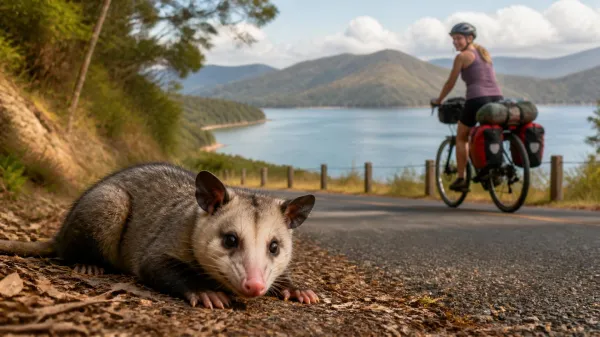
The term “traveling under your own steam” came from the early steam engines, ships and trains that moved using their own internal power rather than being pulled or towed. But in today’s travel lexicon it has come to mean traveling by either walking, cycling, or other forms of travel whereby you use your own energy to move from place to place.
One of the unforeseen consequences of “traveling under your own steam” is the unintentional learning that happens along the way.
Perusing Facebook, I saw a post where someone had posted a picture of an Australian brush-tailed possum climbing the wall inside their house. It was a humorous post where they speculated that their cat was in collusion with the possum. The body of the animal was covered in a thick plush fur, as was the bushy tail.
The first reply came from a Facebook user in the United States. “That’s not an opossum, that’s a squirrel!” they replied.
300 people instantly hit the “like” button without further investigation.
Minutes later there were 500 users all agreeing it was a squirrel, not an opossum.
Some posters even offered pictures of their own encounters with an opossum. A shaggy, coarse-haired rodent-like creature with a long hairless tail like that of a giant rat.
Native, non-native
Being a native of North America I instantly saw the problem. Opossum, spelled with an “O” is a marsupial that is native to North America. Highly adaptable, they range all over the continental United States. Most people in the U.S. have encountered them in person. They do indeed resemble a large coarse haired rodent.
A Possum, no “O”, is a plushy fur-covered marsupial native to Australia, an invasive species in New Zealand.
I tried to offer my perspective by pointing out that the picture was of a “Possum” not an Opossum. I was quickly corrected. It was suggested that I “check the dictionary for how to spell opossum”.
Possum, in person
How did I know the difference? While spending half a year cycling New Zealand and Australia, I had encountered the creatures firsthand. Possums are curious by nature and although shy, they are resourceful, and on more than one occasion I woke to find one rummaging through my tent for food. I asked locals what these plushy animals were, that looked like a cross between a koala
bear and a meerkat to me.
Possum, I was told.
I also encountered signs in New Zealand informing me they had become an invasive species there.
Unintentional learning
Thus is the nature of travel. You learn all kinds of strange facts and bits of information. It is inherent that by putting yourself in a new environment, you will learn all sorts of fun and interesting details and specifics about where you are.
The saying “travel broadens the mind” comes to mind. In this case, unintentionally. I did not set out to educate myself on the differences of a North American Opossum, and an Australian Possum, it just happened. Thus is the beauty of travel, especially “travel under your own steam,” where you have ample opportunity to learn all kinds of new things as you make your way from point A on a map to your chosen destination.
It can provide invaluable immersive learning experiences that transcend classroom settings, offering unique opportunities for firsthand discovery, and a deeper more connected understanding of the world simply by putting yourself in the situation of traveling under your own steam.
Personally, I believe it also encourages cultural awareness, boosts creativity and problem-solving, as well as increasing self-reliance and confidence.
But the best experience depends on one’s attitude while traveling. Embracing new experiences, seeking genuine connections and having an openness towards personal growth is what makes travel a remarkable experience, not merely the act of moving one’s body to a new location. Be inquisitive, talk to locals and fellow travelers, ask questions, and be open to new experiences.
While the physical act of traveling is a start, it is the mindset of curiosity and openness that truly allows the journey to expand one’s perspective.
Partner